Black Artist and Black Humanity
In the wake of the popularity of the Black Lives Matter movement in the Summer of 2020 and continuous protest against racial violence, and on the heels of the Derick Chauvin’s Trial , Black people’s death has been front and center. For activist, organizers and everyday Black people the hyper-visibility of Black death poses a set of difficult problems. For one the news coverage of police brutality and racial injustice is an important way to increase public awareness and spur policy change. However, the constant visuals of Black people’s death and suffering is traumatizing and overwhelming. Especially since news outlets are comfortable showing Black people’s violent death. Yet they would not dare show the death of White bodies in a similar manner out of respect for their humanity. A person’s death is b-roll playing in the background of T.V. commentators debating whether or not the deceased deserved the right to live.
Even though some propose that seeing such brutality can spur sympathy from white masses yet forget that Black death is America’s favorite pass time. Whole entire White communities enjoyed festivities and picnics while watching Black people being lynched. Perhaps now this pastime has taken on a more insidious place in watching Black people die over and over again on our TV, computer, and phone screens. In various mediums like film and television an emphasis on Black peoples suffering for shock value is produced for White entertainment. However, this content is not made with a Black audience in mind. Black people already know they suffer, they already know that they die, so constant reminder through media is traumatic.
Black artist have had various reactions to the constant burden of viewing black victims. In this exhibit, Finding Life in the Face of Death, I will highlight artist who attempt to show black people in the full scope of humanity. I hope to examine how artists depict black people during times of mass coverage of Black people’s death and suffering. This focus on Black people’s humanity may be in abstract fantastical settings, commemorating victims of police brutality or in the beauty of everyday life. Pieces will be covering the range of human emotions of joy, ambivalence, pride, and depression. These pieces are made after 2013, coinciding with the development of the Black Lives Matter movement. Some artists are responding directly to protest and activism surrounding police brutality, addressing the victims and reimagining them through art. Others will have nothing to do directly with the Black Lives Matter movement and are the artist own reflection of Black life. They are sharing the full range of humanity that they experience and recognize in other Black people. The effects of police brutality, the hyper-visibility surrounding Black People’s death, and Black Lives Matter movement are inescapable for Black people. For all of these artists regardless of whether or not their art directly comments on Black peoples death, they all recognize Black life. I am very proud to showcase pieces from well acclaimed artist, up-and-coming legends in the making, and talented young artist that I have the pleasure of calling my friends, as they find and the life in the face of death.
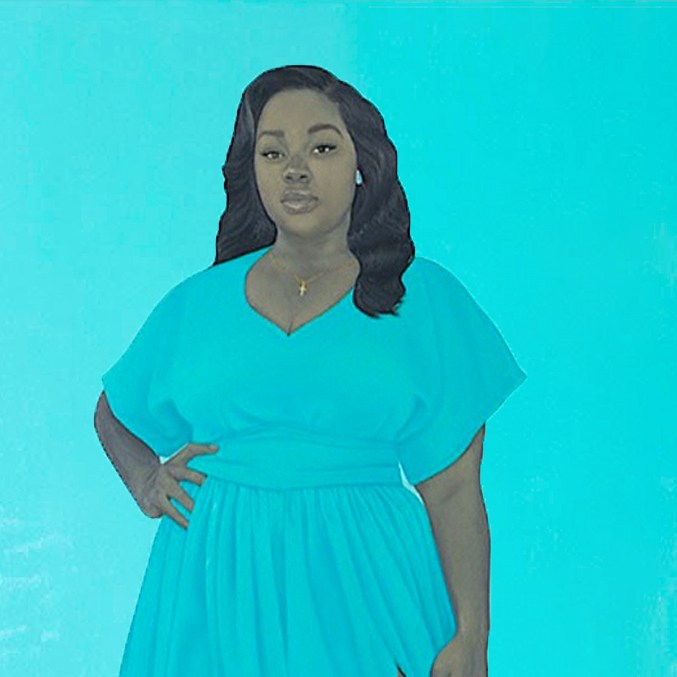
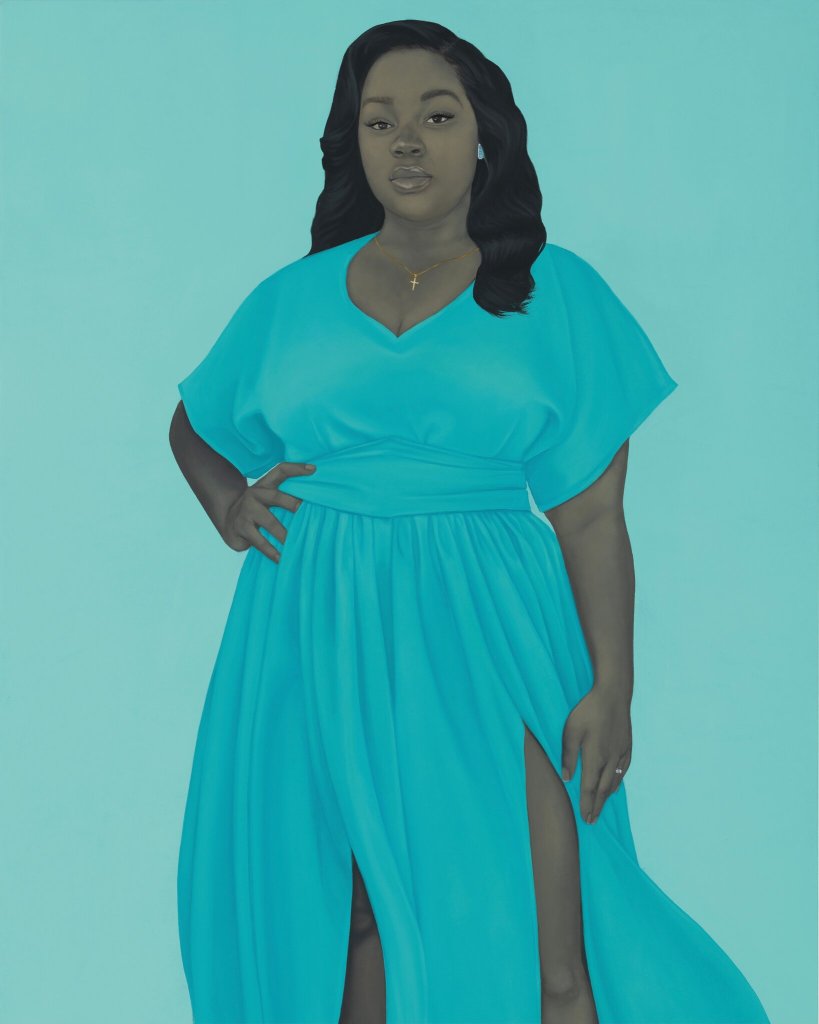
In this breathtaking portrait Sherald showcases Breonna Taylor with dignity and grace. Ms. Taylor was murdered by police officers issuing a no-knock warrant in March 2020. Her death and the subsequent acquittal of the police officers has sparked social justice movements around the world. Sherald chose to paint Ms. Taylor in a turquoise dress and background, one that is reminiscent of the oxides blue copper of Lady Liberty. Questioning the importance of the virtues that Lady Liberty represents and their application to Black life in America. Ms. Taylor’s gaze is steady and direct and confident but has a warmth and humanity to it. Her pose is realistic and familiar using the way Ms. Taylor’s poses in her own personal pictures as inspiration. The posing gives Ms. Taylor in this portrait a breath of life and naturalness, that counters any underlying stiffness that portraiture may evoke. As the Black Lives Matter movement grows, imagery and media have been key in humanizing victims, Sherald’s portrait has been used throughout social media and traditional media for this purpose. It has a physical home in the Speed Museum in Louisville Kentucky, in Breonna Taylor’s hometown, Sherald notes how important it was for her to assure the portrait was accessible to Ms. Taylor’s family and friends. But the portrait also has found its place the cover of Vanity Fair, news reports and social media hashtags and posts, and is seen around the world.
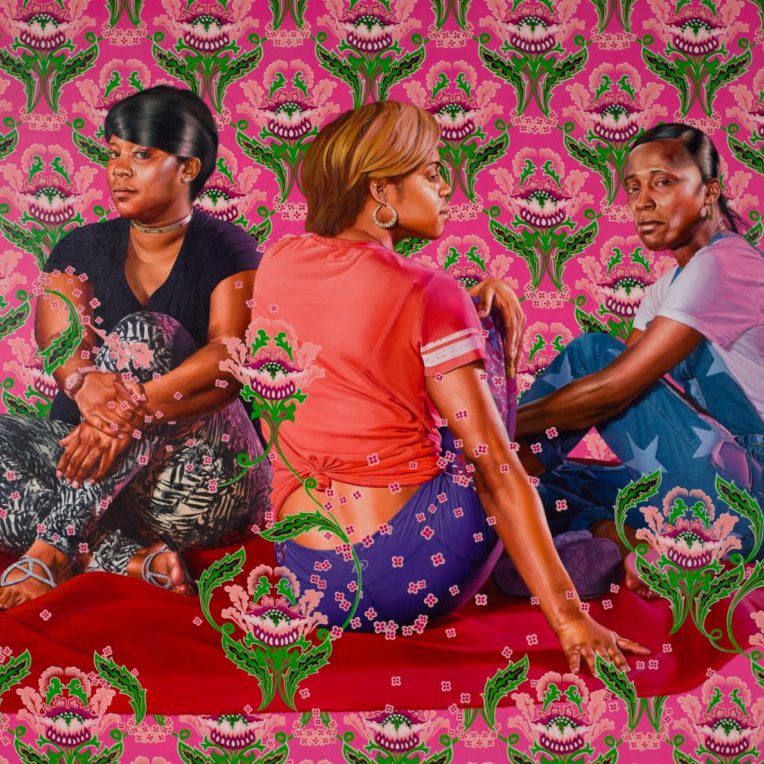
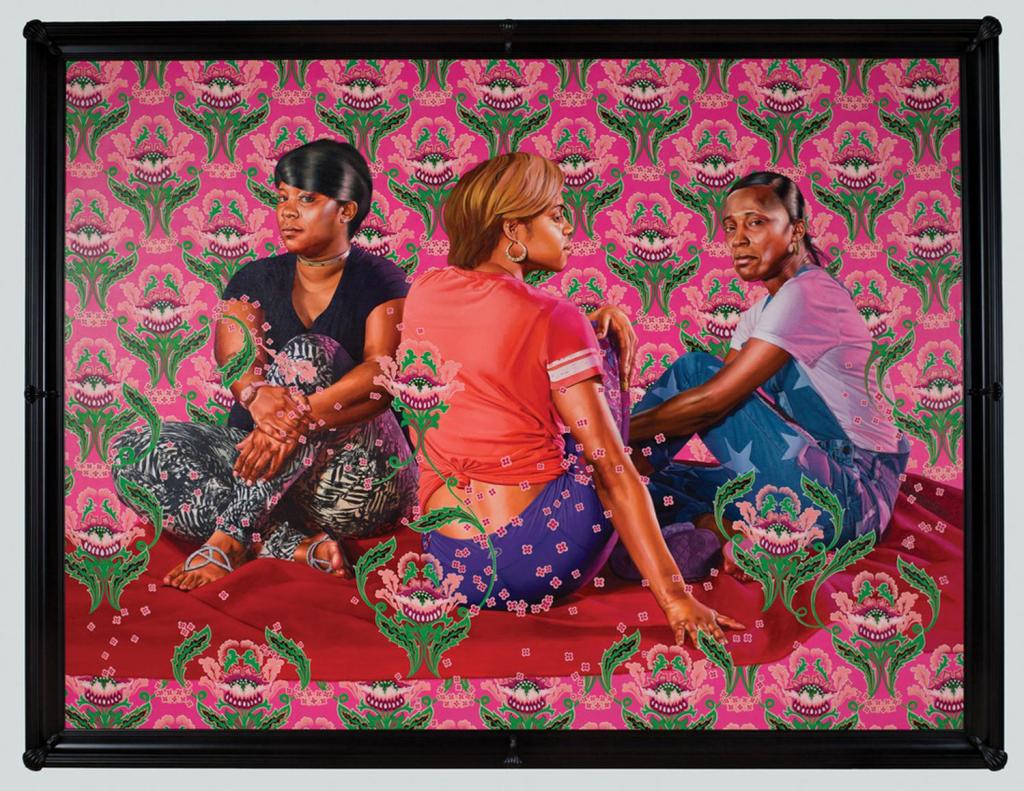
“Three Girls in a Wood” by Wiley displays three women of various ages posed sitting in casual clothes. These girls are hardly girls, and seem more like grown women, as their steady gaze looks out at the viewer. In this vulnerable and intimate pose they sit on the floor near each other, possibly reminiscent of their girlhood as they connect with one another. Upon first glance viewers may question the woods that the title insinuates, considering that these women aren’t in a forest environment. Instead, Wiley uses a key element that occurs across his work: a bright and colorful patterned background that contrast the naturalistic form of his human subjects. The pattern is of pink flowers with luscious green vines repeated in the background, however some of these flowers are also brought to the foreground. This painting is a nod to the 1920 piece of the same name, by Otto Muller. In Muller’s painting he creates a landscape of nude women of a primitive non-western world emphasizing exotic stereotypes. Wiley re-imagines this scene as he shows Black western women, who have a much greater level of agency compared to Muller’s original piece. They interact with the viewer through their gaze, and are in a vulnerable and intimate space, almost inviting the viewer to join them.
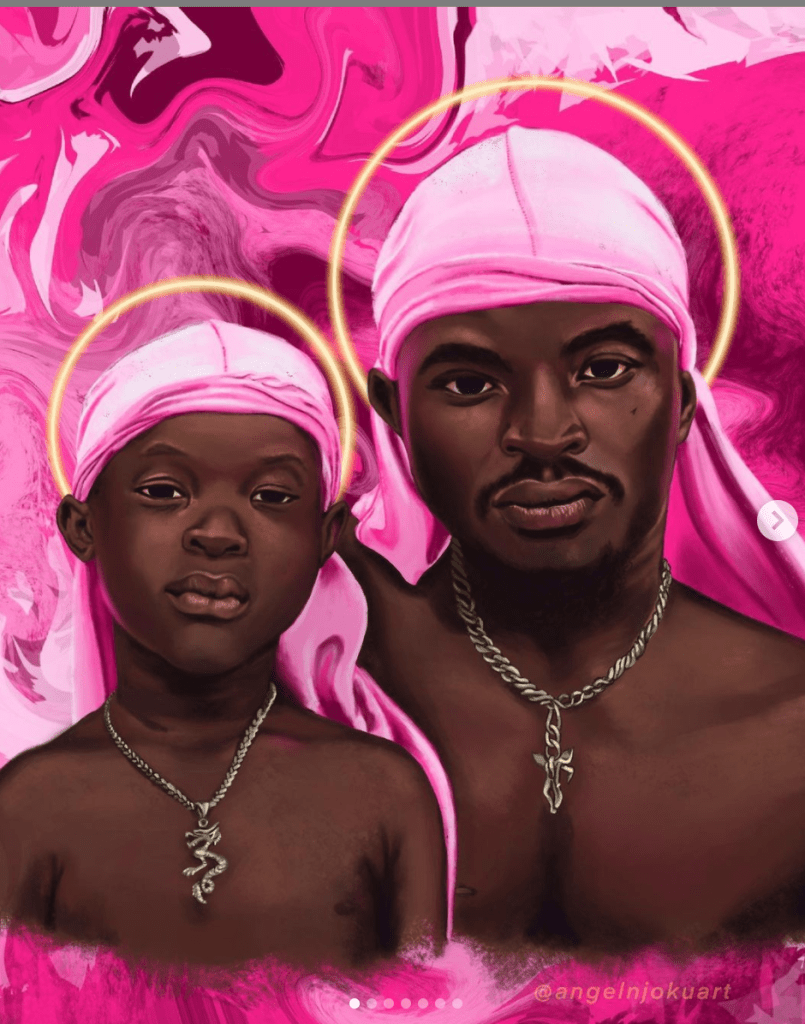
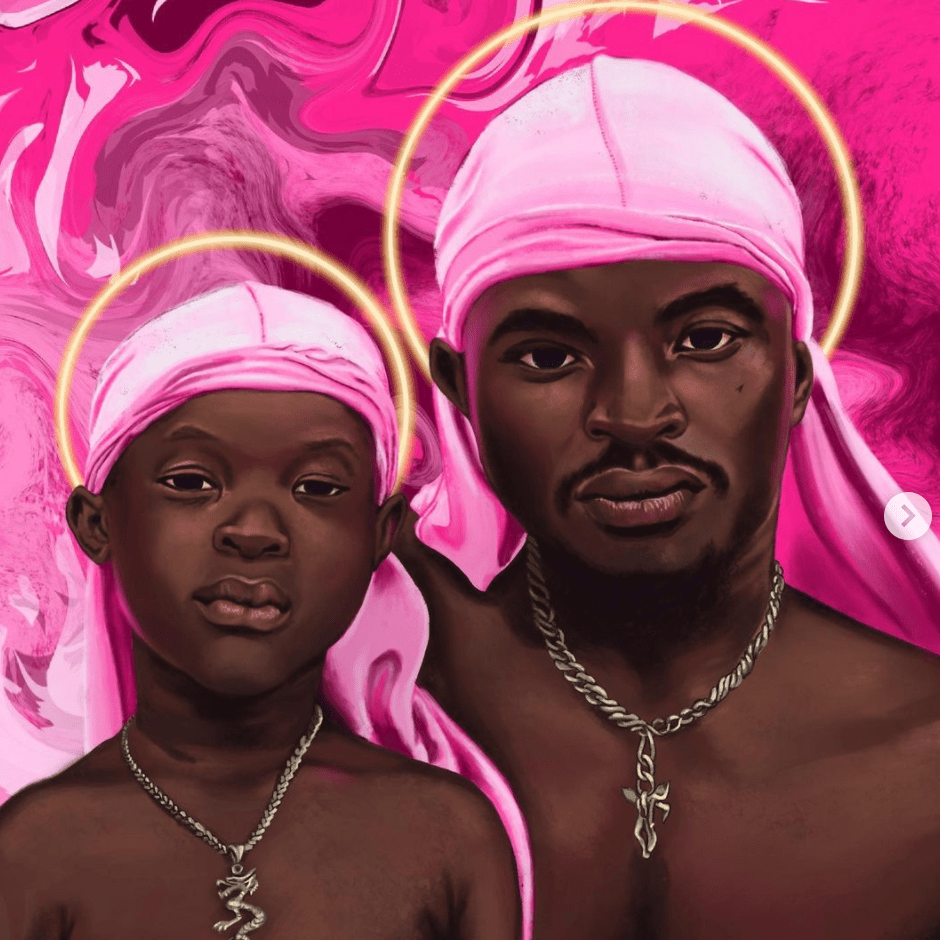
In “Like Father, Like Son,” artist Angel Njoku (sister of Uzo Njoku) paints a breath taking image of a Black father and son duo with pink durags, surrounded by a pink textured background. Njoku bases this drawing off of a photograph of the two with great detail through a digital painting platform. The pink durag is a common staple in Black male haircare and an aesthetic choice. The father figure passes down this tradition to his son, who looks so similar to him. They have similar faces, jewelry, and expressions stressing the intergenerational relationships, yet the difference in age emphasizes their individuality. Njoku adds halos around their head, evoking religious imagery of the Mother Mary and Jesus. This is an interesting choice considering the difference in father son relationship but highlights it as a sacred bond. The pink color contrast the masculinity that Black men are often associated with. The color choices challenge gender stereotypes of black men through evoking vulnerability and by highlight father son dynamic, that is often overlooked. Njoku invites viewers to consider the importance of Black familial relationship in a space of love, vulnerability, and as vehicle for passing down culture.
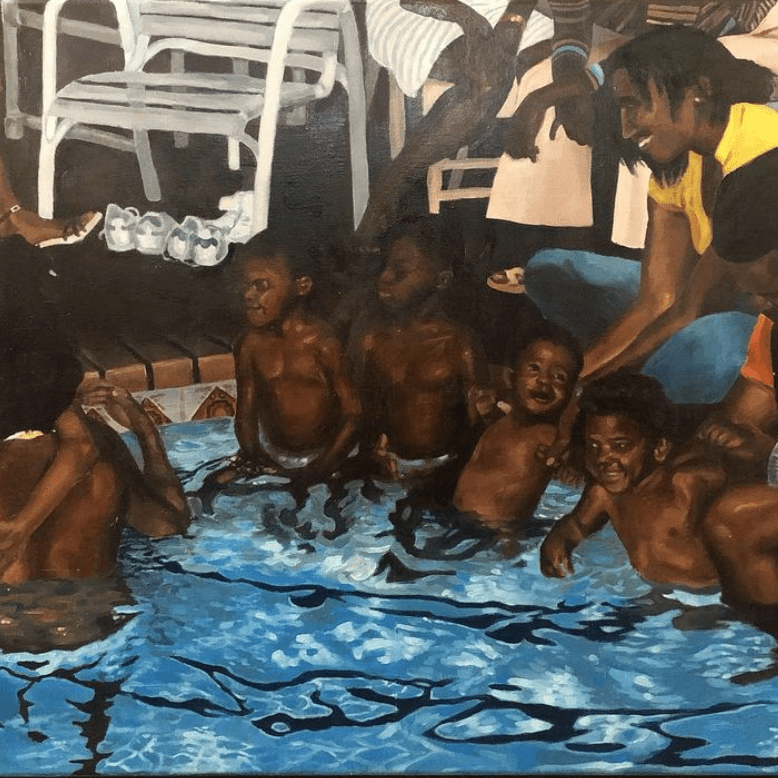
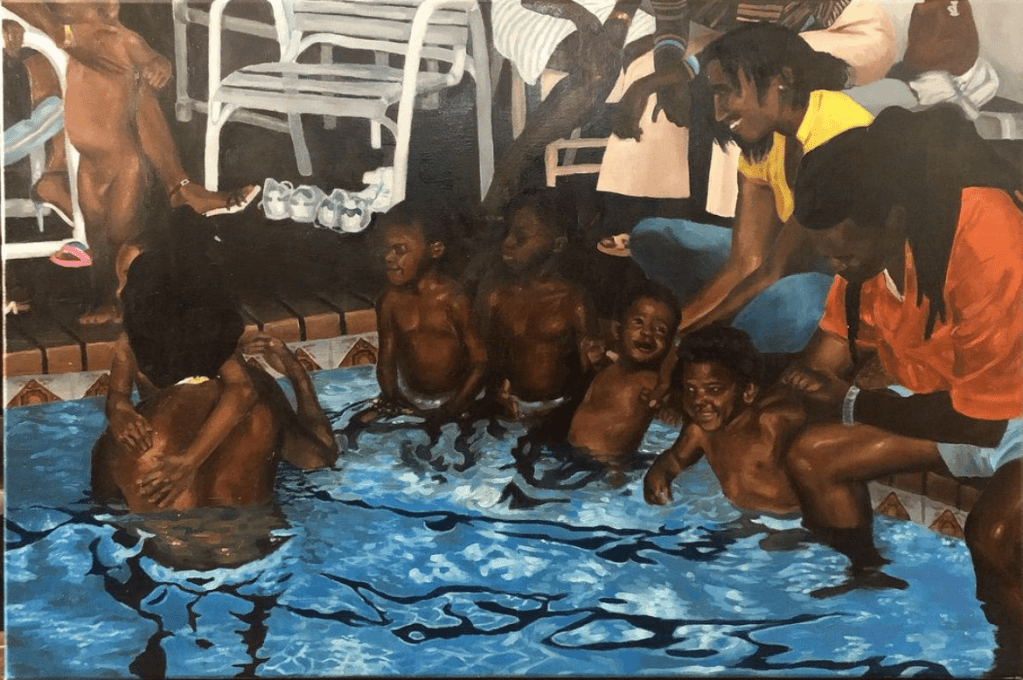
Semexant paints a scene that is familiar to many Black people of a get together surrounding a pool. This casual setting is filled with joyful yet watchful parents and playful children enjoying each other’s company. Semexant uses a painting technique with mid-size brush strokes that allows for the characters to all have distinct and individual faces and characteristics through an attention to detail that isn’t necessarily focused on hyper realistic. The use of oil paint allows for Semexant to skillfully showcase texture, especially through water. The pool is a central part of the painting that brings everyone together and is treated with care as he displays distortion and reflection from the water. In this scene viewers are encouraged to reflect on the many ways that Black people find joy in youth, family and community building. In these small moments childhood memories that will last a lifetime are being made.
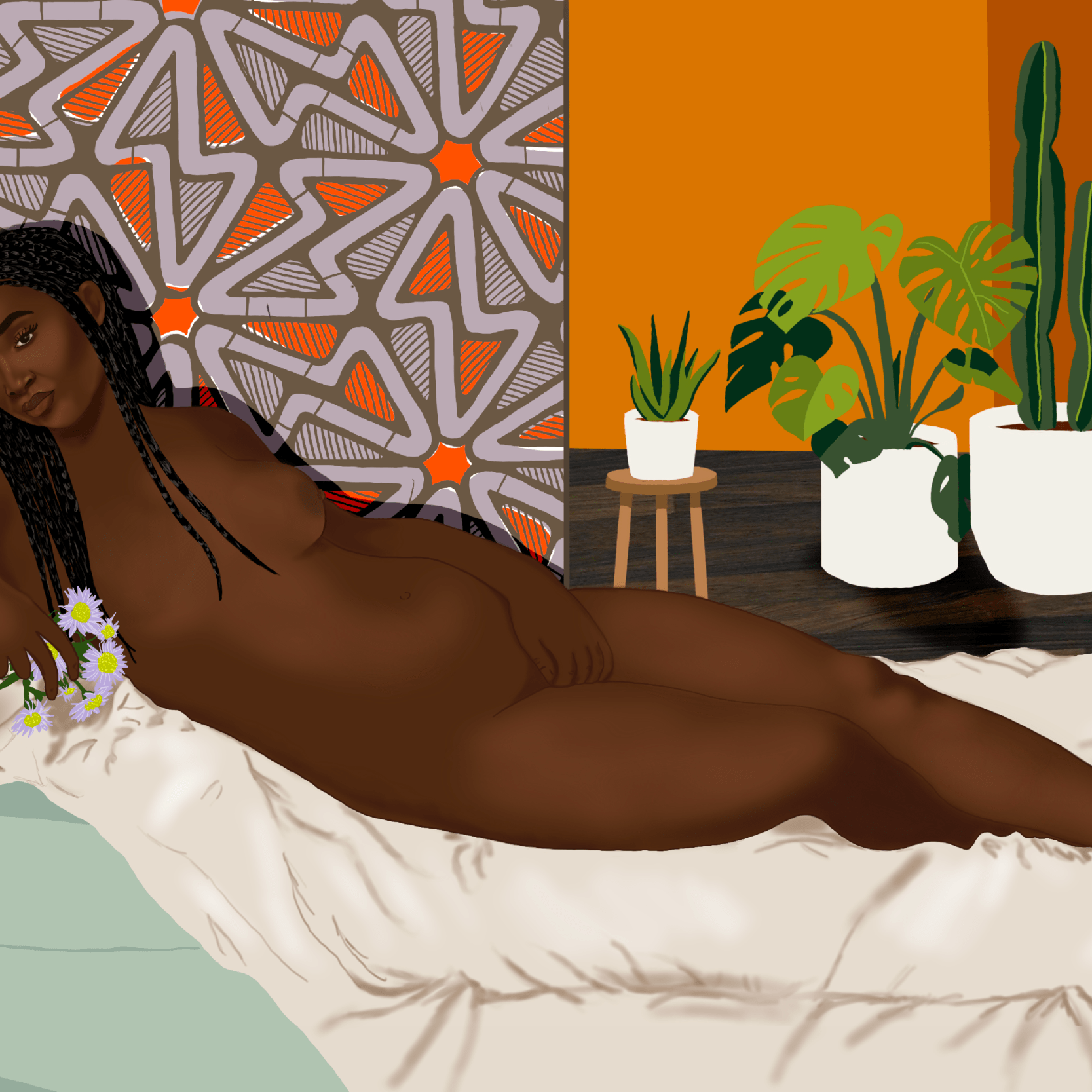
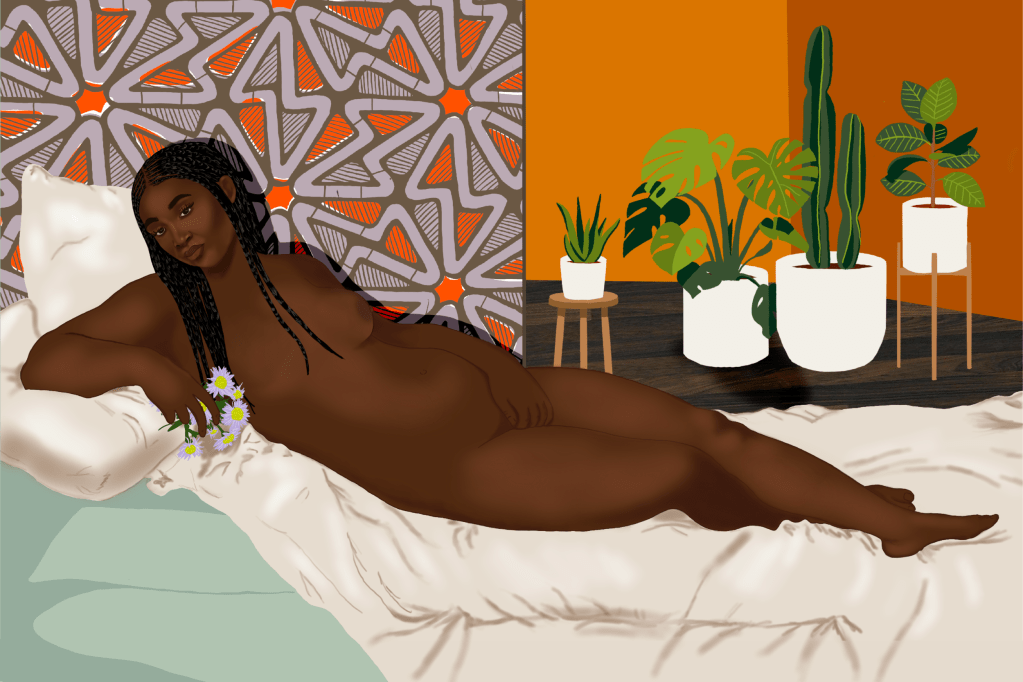
Artist Uzo Njoku (sister to Angel Njoku) creates a breath-taking self-portrait evoking the many variations of the classic Sleeping Venus. This painting puts the Venus in a modern context, with brightly patterned walls centering the beauty of a Black woman. Njoku challenges usual dynamics of classic Sleeping Venus variations in many ways. Agency of the female subject contrasts a similar scene of Venus of Urbino by Titian, where Njoku herself is the painter and the subject. Compared to Titian who is a male painter portraying a goddess, using a sex worker as a model. Njoku evokes Titian’s piece through posing and the setting of the painting yet adds new meaning. Classic Sleeping Venus pieces tend to be marital gifts focuses on the male gaze. Whereas Njoku’s piece is informed by her own vision of self, and her own bold work of self-representation. Similarly to classic Sleeping Venus pieces her face is graceful and beautiful, and her hand similarly covers her gentiles, evoking a modest disposition. Her hair is in a common braided style for Black women, and the room styled in a contemporary fashion, allowing us to imagine the Sleeping Venus as a 21 century woman who is determining their own sexuality.
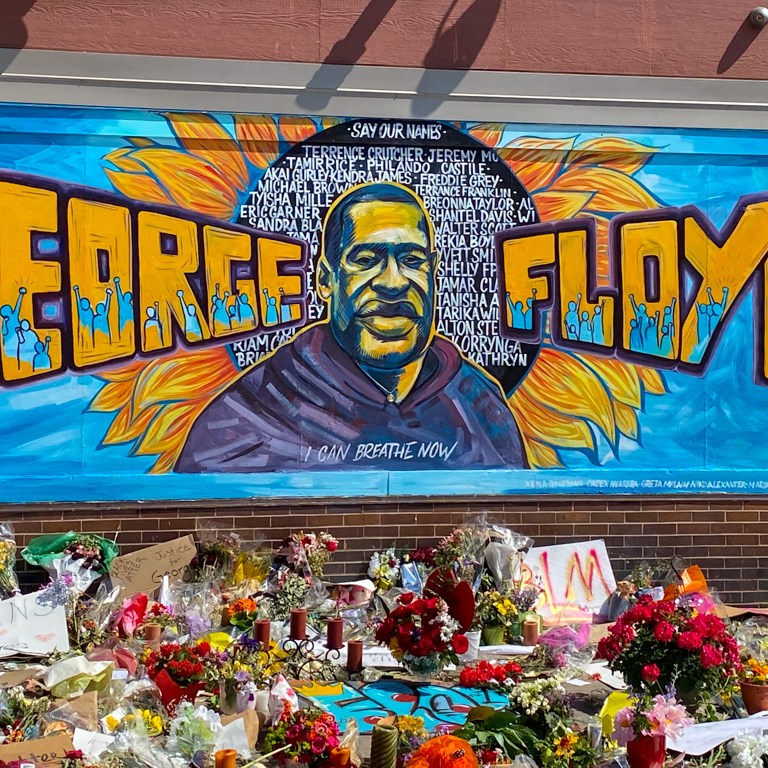
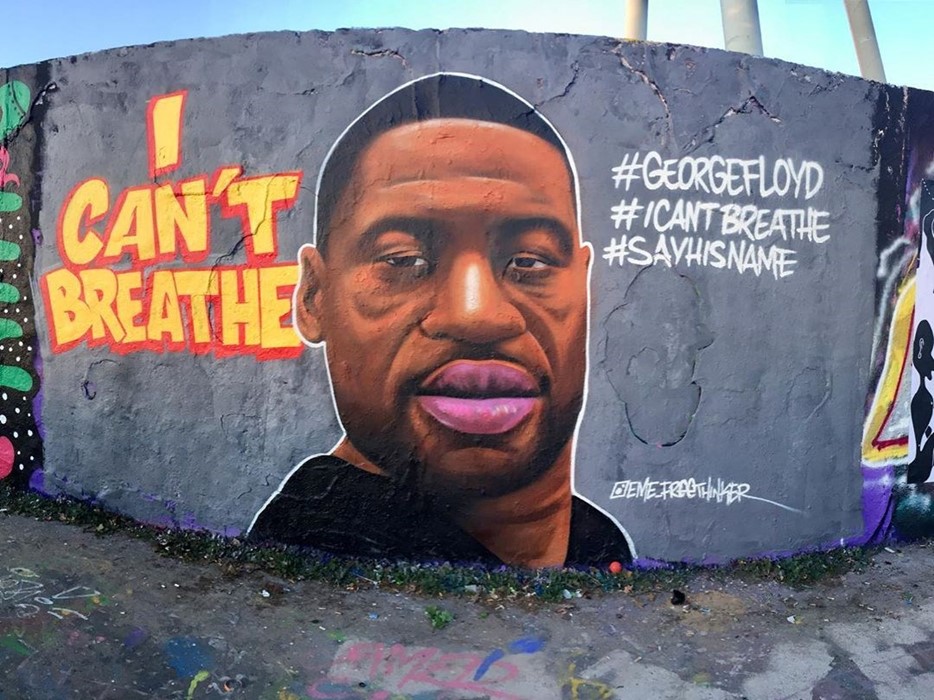
This vibrant mural greets the city on Berlin, in the few remaining pieces of the Berlin wall, to commemorate the murder of George Floyd. EME Freethinker, an Afro-Caribbean artist based in Germany, started this piece soon after the video Floyd’s murder wen’t viral. Using his graffiti art background, Freethinker creates a portrait of Floyd based off a popular picture. He uses various spray paint techniques, to create the various shadows and lines that define Floyd’s face. With bright yellow colors Floyd’s last words are written beside him. Similar murals have been reproduced across the world in the name of Floyd. These murals are generally common in urban setting to immortalize victims of violence along with heroes. This tradition of mural painting seek to acknowledge people, especially as impactful parts of community, and create a space for mourning, remembrance, and protest. This particular mural has been defaced and has had to be repainted to preserve it. This mural has a complex relationship with imagery and agency of the subject, as Freethinker noted a few own lookers commentated that “You have to do it with the police over his neck,” when referencing how Floyd is depicted. Freethinker strongly disagreed and repeatedly stresses the importance of not reproducing images of the brutal death of black people, noting that it’s something the world is already aware of, but rather on memorializing life.
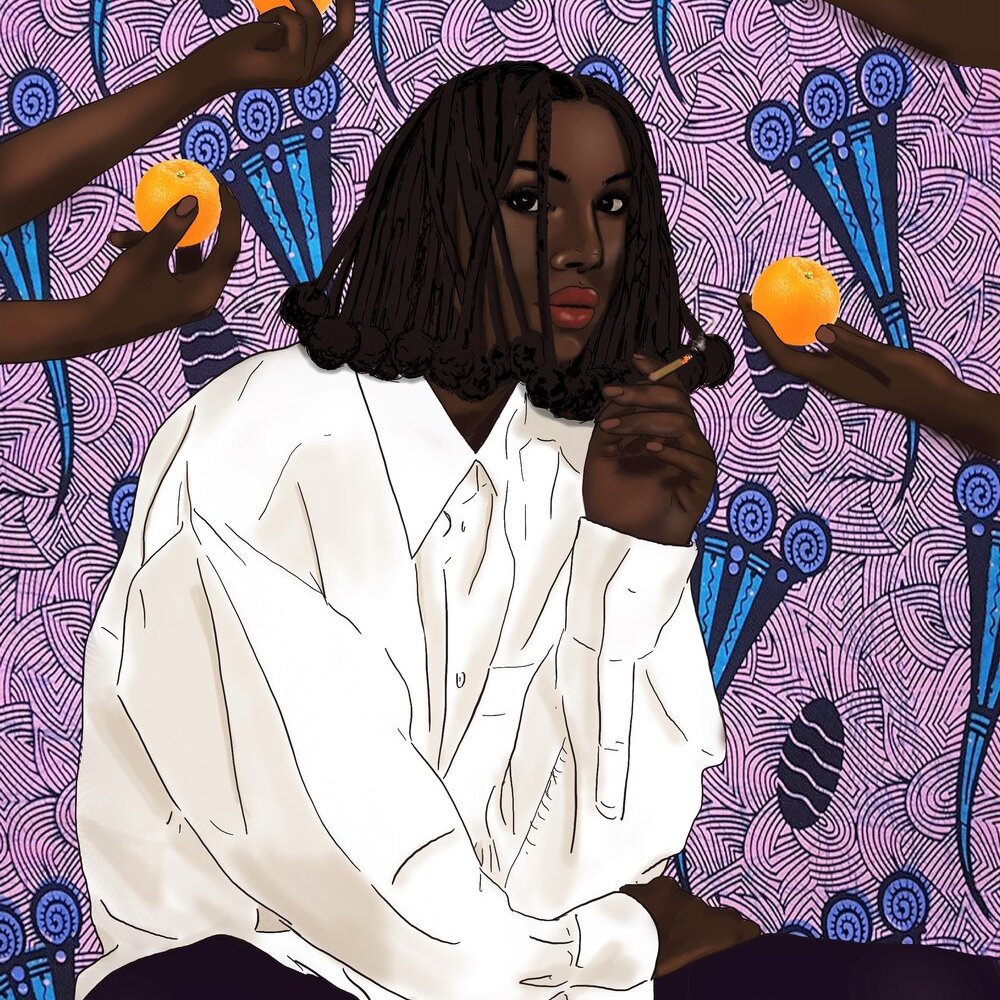
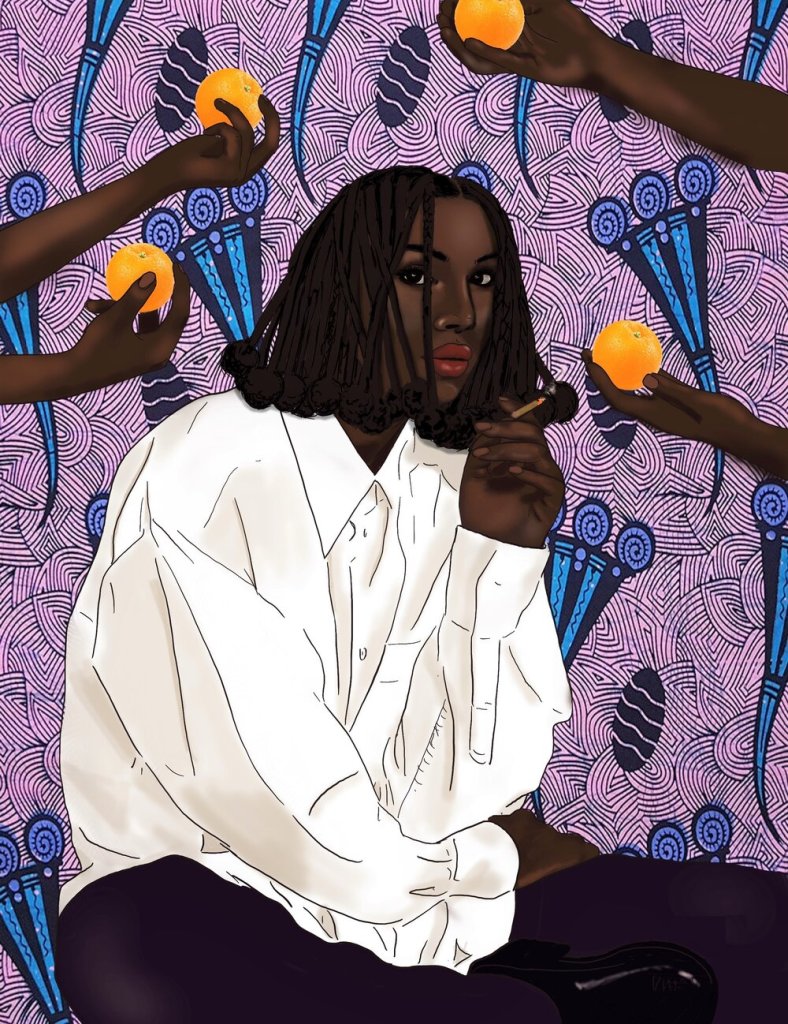
With a colorful purple patterned background, the central figure of a Black woman hunches over with a cigarette, surrounded by hands holding oranges. Njoku reminisces that this painting was made as she imaged an alternative career path as an orange farmer, if she were not an artist. The Black woman who graces the foreground, constrast the vibrant background colors, with a muted white button down. Her face slightly obscured by braids, as she looks back at the viewer with a nonchalant gaze. Almost asking the viewer, why are you staring at me? A play on words with the saying, “When life gives you lemons,” the piece uses oranges for the metaphor of life’s adversity. Black women are no stranger to the difficulties of life, and are expected to respond with grace, consideration and patience. Black women are expected to make lemonade without a fuss. However, the subject with her cigarette, and backed hunched over is uninterested in the oranges of life and the optimism that expects her to make orange juice with them. Instead she prefers to take time for herself, ignoring the oranges.
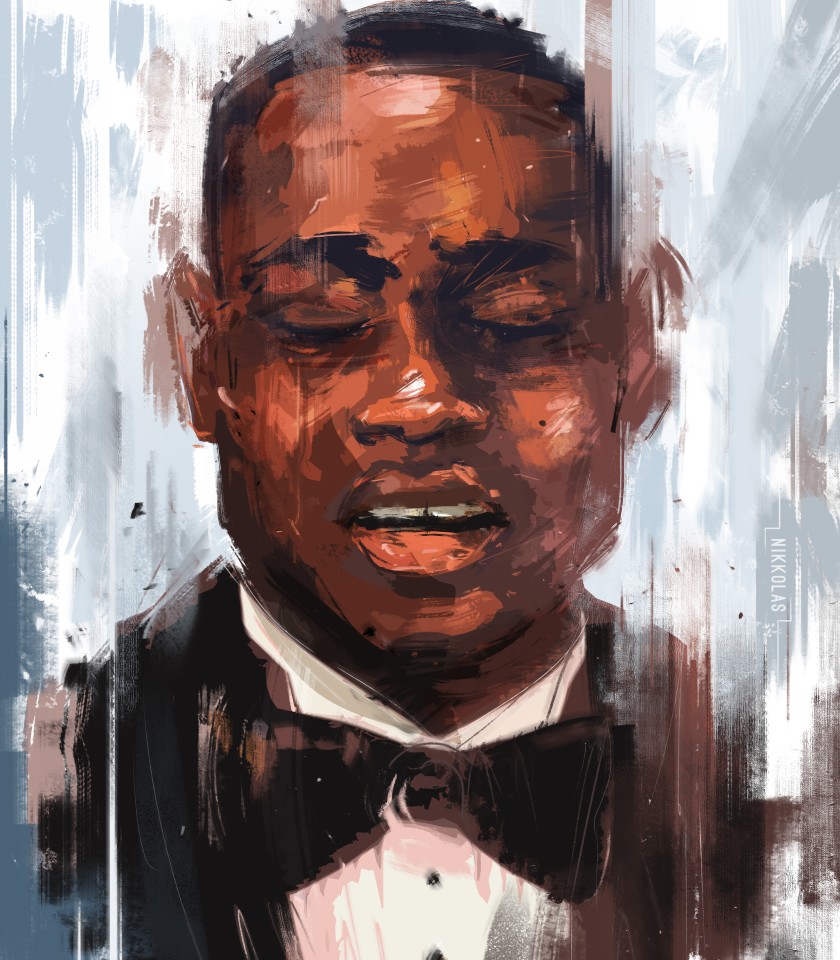
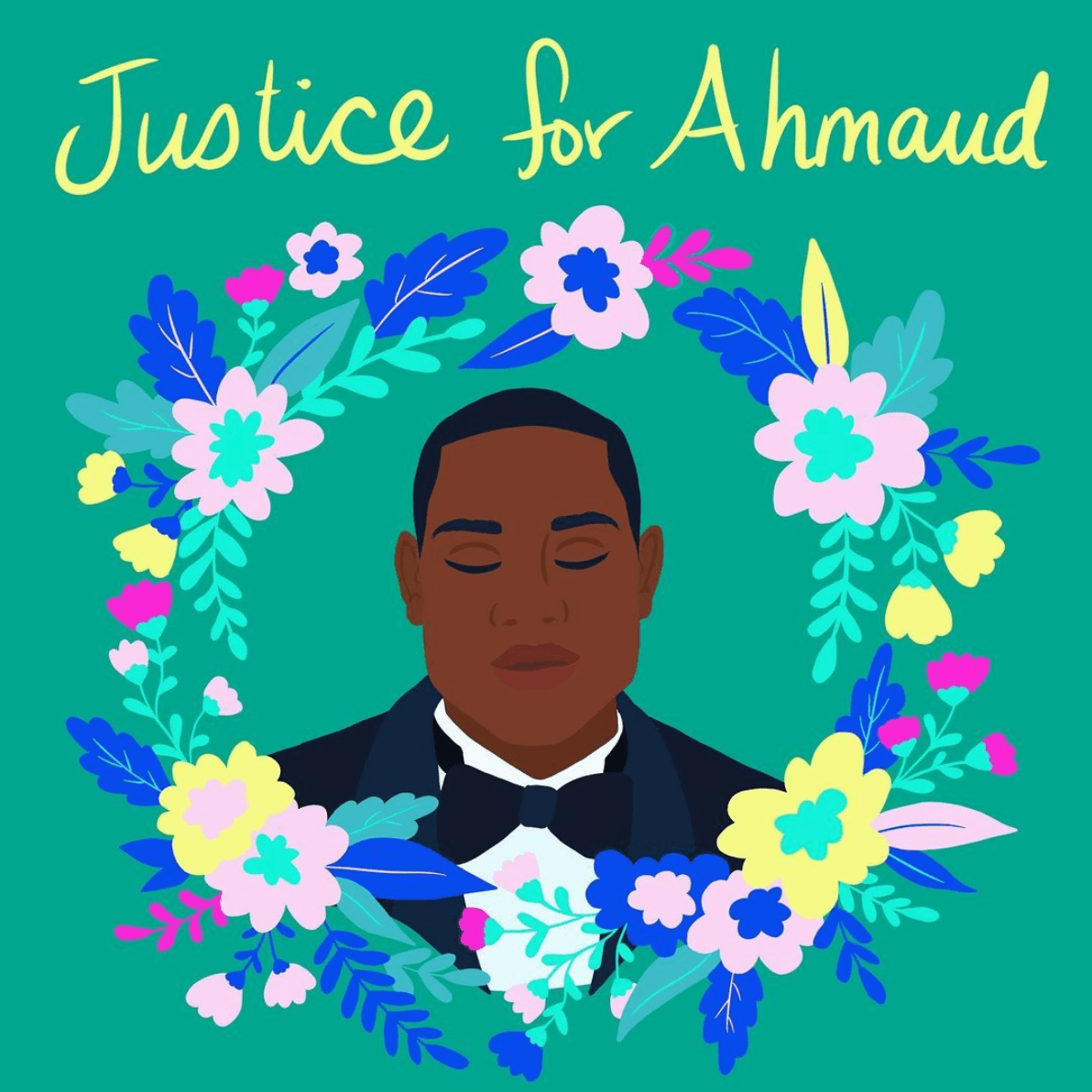
Through digital painting, artist Nikkolas Smith reimagines a well circulated image of Ahmaud Arbery. The reference photo is of Arbery proudly smiling for his graduation picture, is reinterpreted as one of his agony. Smith notes the anger he felt when learning about Arbery’s unjust murder and sought to represent the pain that reverberated through the hearts of millions. Arbery’s eye’s are close with a slight tension in his brows, as his mouth remains agape as he prays. Smith uses large violent brush strokes in this portrait, yet is able to accurately represent Arbery’s distinct face. This brushing technique adds to the anguish that Arberys face expresses. Smith’s pieces recons with the tension between commemoration and martyrdom that are often in conflict in protest art. An attempt to honor victims may stretch into martyrdom to help invigorate communities as they seek justice. Yet this often strips the agency of victim, positioning their death as a sacrifice needed towards the demand for justice. In constrast, Smith emphasizes the pain, vulnerability, and agony of Arbery’s death without visually displaying the violence itself. Through Arbery’s expression, viewers are reminded that his death was not the sacrifice of a hero but the murder of an innocent man. A man who had loved ones, dreams, and had a God who he prayed to.
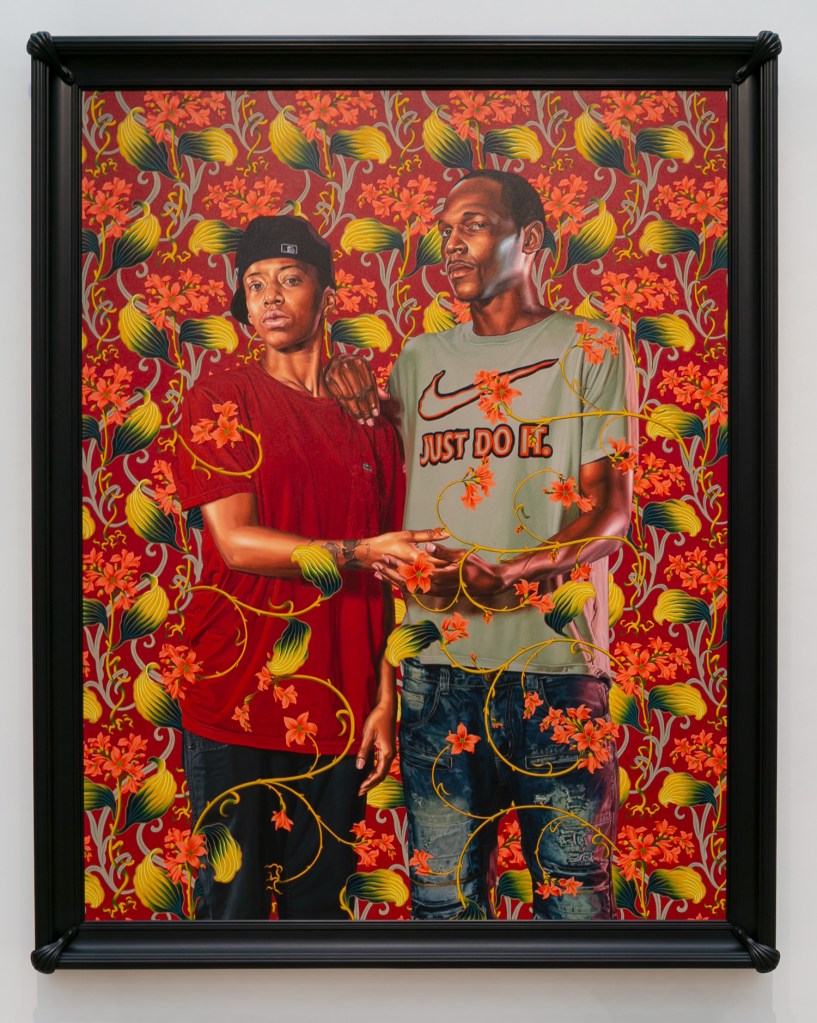
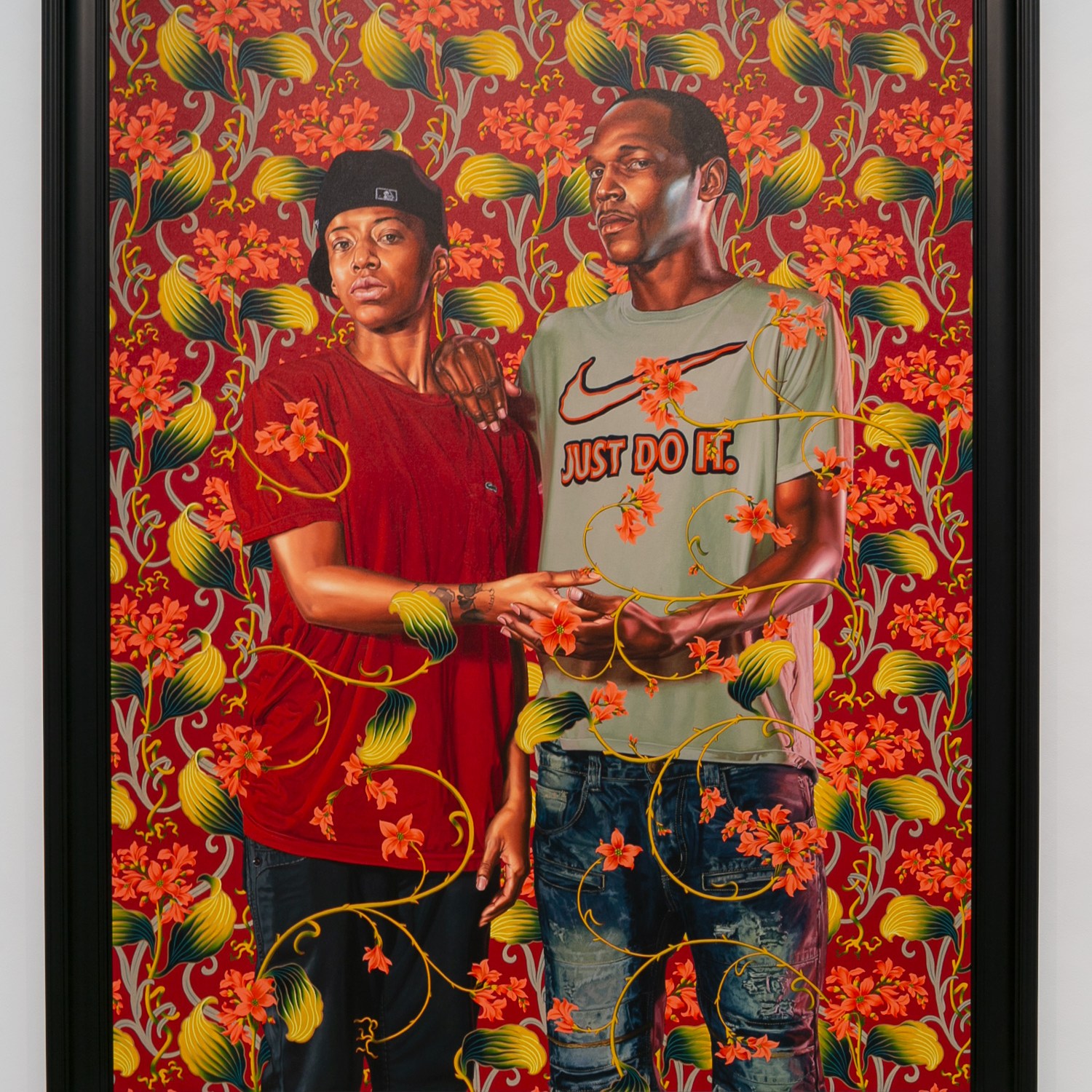
Two Black young men, in contemporary urban fashion join hands, and lean on each other, as their gaze remains steadily on the viewer. This intimacy is not usually highlighted in relationships among Black men, due to pressures to perform masculinity. Yet these two friends come together closely, as they stand. The realism of the male subjects contrast with the patterned background that surrounds them, placing them in. Contrasting the casual dress of these young Black men, in an ornate and decorative background, Wiley places characters in a fantastical setting that demands viewers to reinvestigate how they imagine Black people. Their steady gazes invites viewers to interact with such realist figures in a fantastical world of bold patterns and growing flowers. To enter a world where those who are expected to be tough, can be vulnerable. A world where the everyday relationships of Black people can also be noteworthy art.
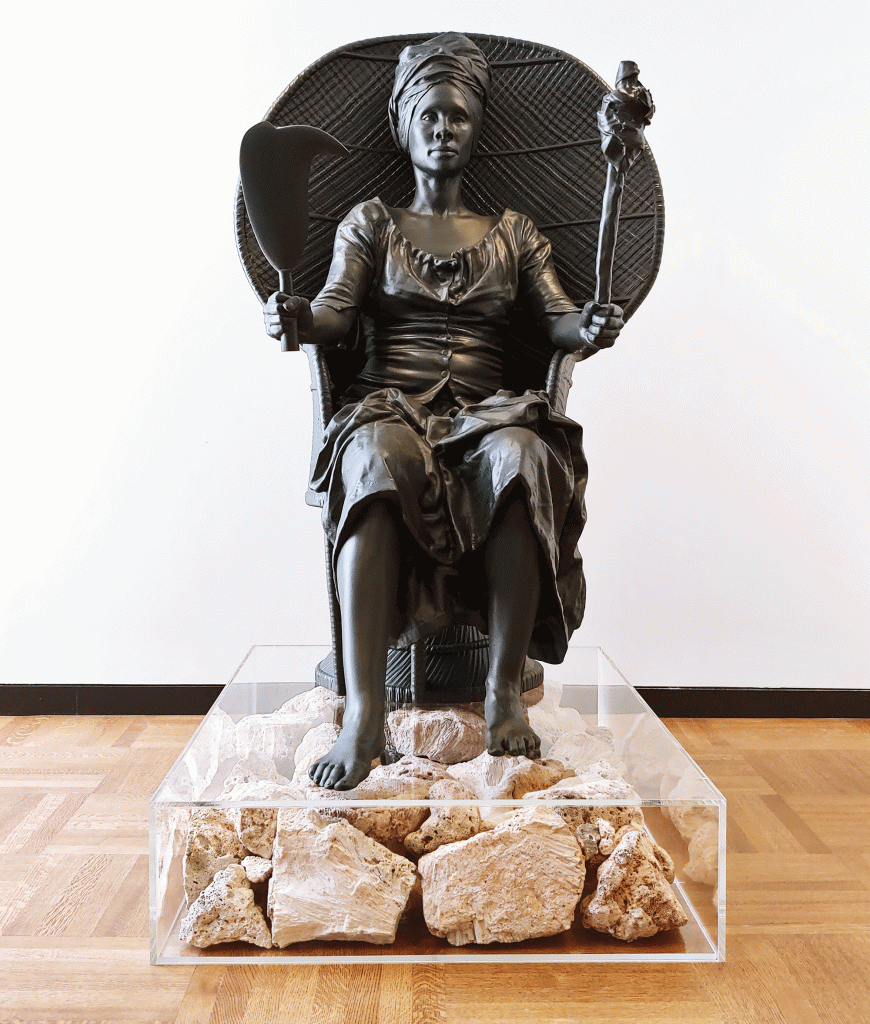
This installation of “I Am Queen Mary,” at Barnard College is a scaled version of the original 23 foot statue located in Copenhagen. Even with a smaller size this version still carries quite a presence. The statue honors Mary Thomas, an enslaved woman from St. Croix who lead an uprising that challenged the Dutch slave system. Queen Mary greets students as they enter Barnard Hall with a torch and cane bill in hand, as she sits in a straw chair. Her pose and chair is reminiscent of an iconic image of Black Panther leader Huey P. Newton. She has a poised expression with her head adorned with a head wrap. Her humble clothes aren’t luxurious, as one would expect from a Queen, but are accurate for her status as a slave and for the time period. She sits graceful on top of a plexiglassed encased coral stones, stones mined by enslaved Africans in St. Croix that served as a foundation material for colonial homes. For viewers in front of the statue the proximity to such a breath taking figure and the pieces of stone that were produced by enslaved people, is a powerful experience. This is the first and onlt statue on Columbia Univerity’s campus of a Black person. This piece brings together various powerful references to classic Black resistance efforts, into one breath taking piece. This pieces centers the work of Black women as revolutionary leaders, and honors a long history of resistance. It remembers the past that lays the foundation for the future of Black life.
Work Cited
Pogrebin, Robin. “Amy Sherald Directs Her Breonna Taylor Painting Toward Justice.” The New York Times, The New York Times, 7 Mar. 2021, http://www.nytimes.com/2021/03/07/arts/design/amy-sherald-breonna-taylor-painting.html.
Pope, Miles. “Amy Sherald on Making Breonna Taylor’s Portrait.” Vanity Fair, Vanity Fair, 10 Sept. 2020, http://www.vanityfair.com/culture/2020/08/amy-sherald-on-making-breonna-taylors-cover-portrait.
“Otto Mueller ‘Three Girls in a Wood.’” Omeka RSS, omeka.wustl.edu/omeka/exhibits/show/primitivism/threegirlsinawood/mueller.
Schmitz, Rob. “In Germany, George Floyd’s Death Sparks Protests – And Artwork That Honors His Life.” NPR, NPR, 8 June 2020, http://www.npr.org/sections/live-updates-protests-for-racial-justice/2020/06/08/872137235/in-germany-george-floyd-s-death-sparks-protests-and-artwork-that-honors-his-life.
Hernandez, Victoria. “Photos: His Ahmaud Arbery Portrait Went Viral. How He’s Captured the L.A. Experience through Art.” Los Angeles Times, Los Angeles Times, 9 May 2020, http://www.latimes.com/entertainment-arts/story/2020-05-09/nikkolas-smith-artist-ahmaud-arbery.
“Painting: Kehinde Wiley.” National Portrait Gallery | RECOGNIZE! Hip Hop and Contemporary Portraiture, npg.si.edu/exhibit/recognize/paintings.html#:~:text=By%20collapsing%20history%20and%20style,a%20barrage%20of%20baroque%20or.
Bcrw. “Barnard Welcomes a ‘Queen’ to Campus.” Barnard Center for Research on Women, 6 July 2020, bcrw.barnard.edu/barnard-welcomes-a-queen-to-campus/.
Price, Melanye. “Please Stop Showing the Video of George Floyd’s Death.” The New York Times, The New York Times, 3 June 2020, http://www.nytimes.com/2020/06/03/opinion/george-floyd-video-social-media.html.
 Kwolanne